The Tennessee Titans finally won a football game.
Not a moral victory. Not a “we competed hard” press-conference win. Not another Sunday where somebody points to one good quarter and tells you the rebuild is moving in the right direction.
An actual win.
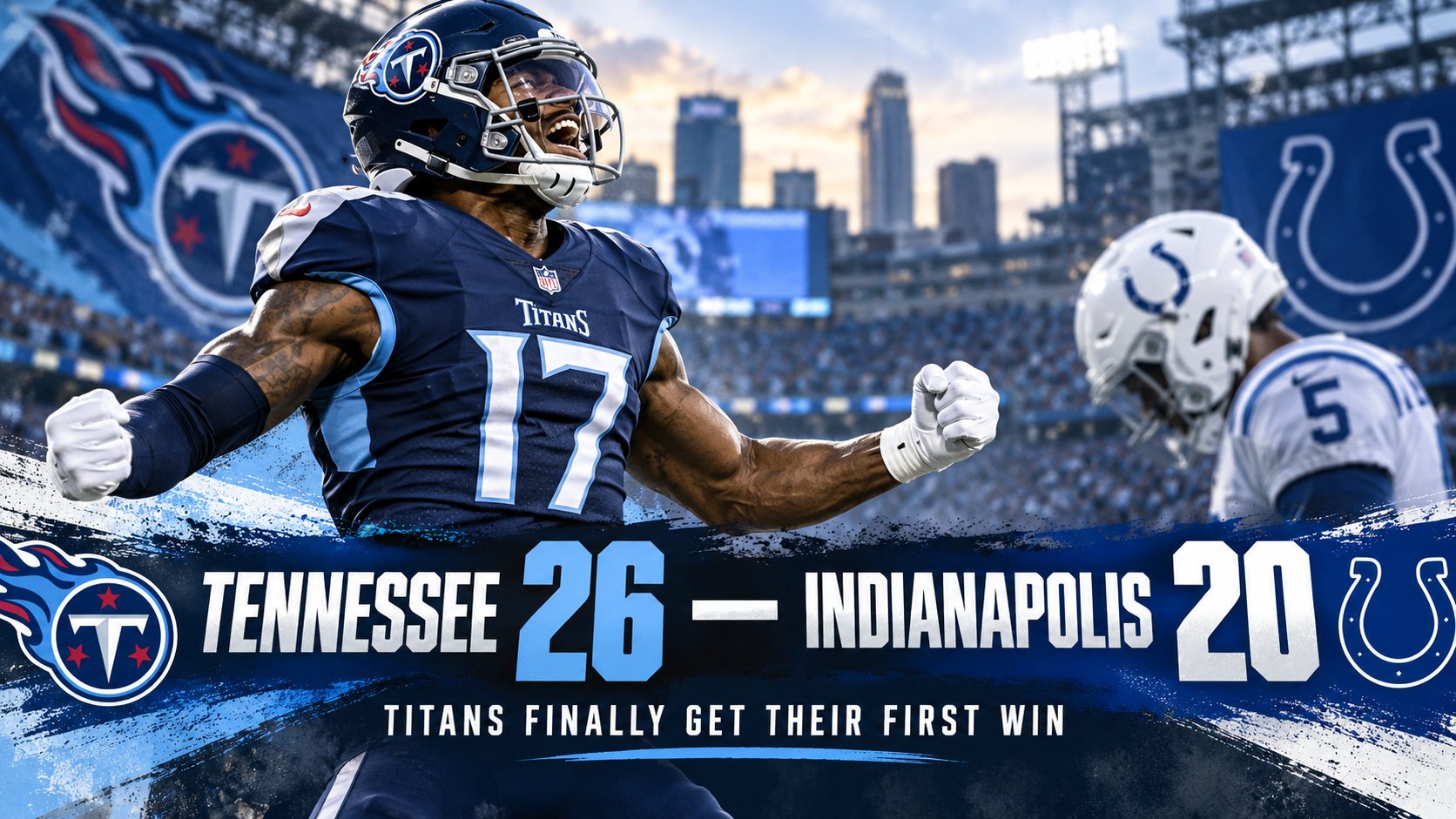
Tennessee went into Indianapolis 0-5, fell behind 13-0 by halftime, produced almost nothing offensively for most of the afternoon, and somehow walked out of Lucas Oil Stadium with a 26-20 victory.
After the way this season started, Titans fans should enjoy the hell out of that.
But they should also be able to hold two thoughts in their heads at the same time:
The Titans won.
The Titans are still a bad football team.
Both things can be true.
And honestly, Sunday might have been the perfect example of why final scores alone can fool you.
Before Sunday, Tennessee Had Been About as Bad as the Numbers Said
The Titans did not enter Week 6 as some unlucky 0-5 team that was secretly playing decent football. They were bad.
Through five games, Tennessee had scored an NFL-low 58 points. They were averaging 11.6 points per game, 32nd in the league. They were also 32nd in total offense at 246.4 yards per game and 32nd in time of possession at 24:31 per game.
One week earlier, Houston came into Nashville and beat Tennessee 26-3. The Titans managed 187 total yards and did not score again after their opening-drive field goal.
That was not some isolated ugly Sunday, either. Tennessee had scored 10 points or fewer three times in its first five games, and the offense had not scored more than 20 points in any of those five games. Cam Ward had thrown three touchdowns through five games. The team had not found a reliable way to sustain drives, create explosive offense or control games with possession.
So when Tennessee went into halftime in Indianapolis down 13-0 — five straight quarters without a point — there was not much reason to expect a comeback. The Titans had given us five weeks of evidence telling us the opposite.
Then the game got weird.
What Tennessee Actually Did Sunday
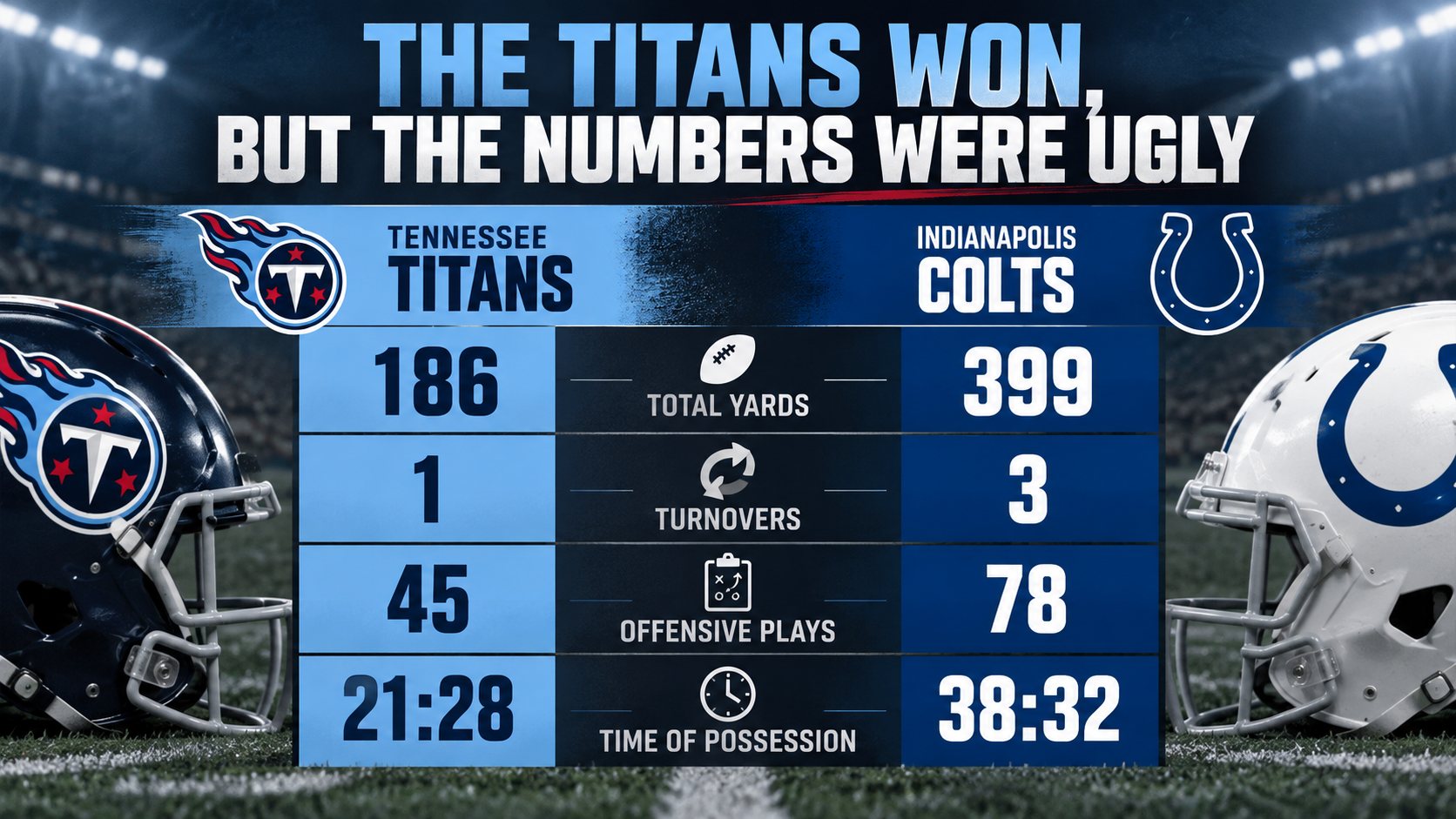
The Titans won 26-20, but the box score still looks like a game Tennessee should have lost.
Indianapolis outgained Tennessee 399-186 and won the first-down battle 24-11. The Colts ran 78 offensive plays to Tennessee’s 45, held the ball for 38:32 to Tennessee’s 21:28, and averaged 5.1 yards per play to Tennessee’s 4.1.
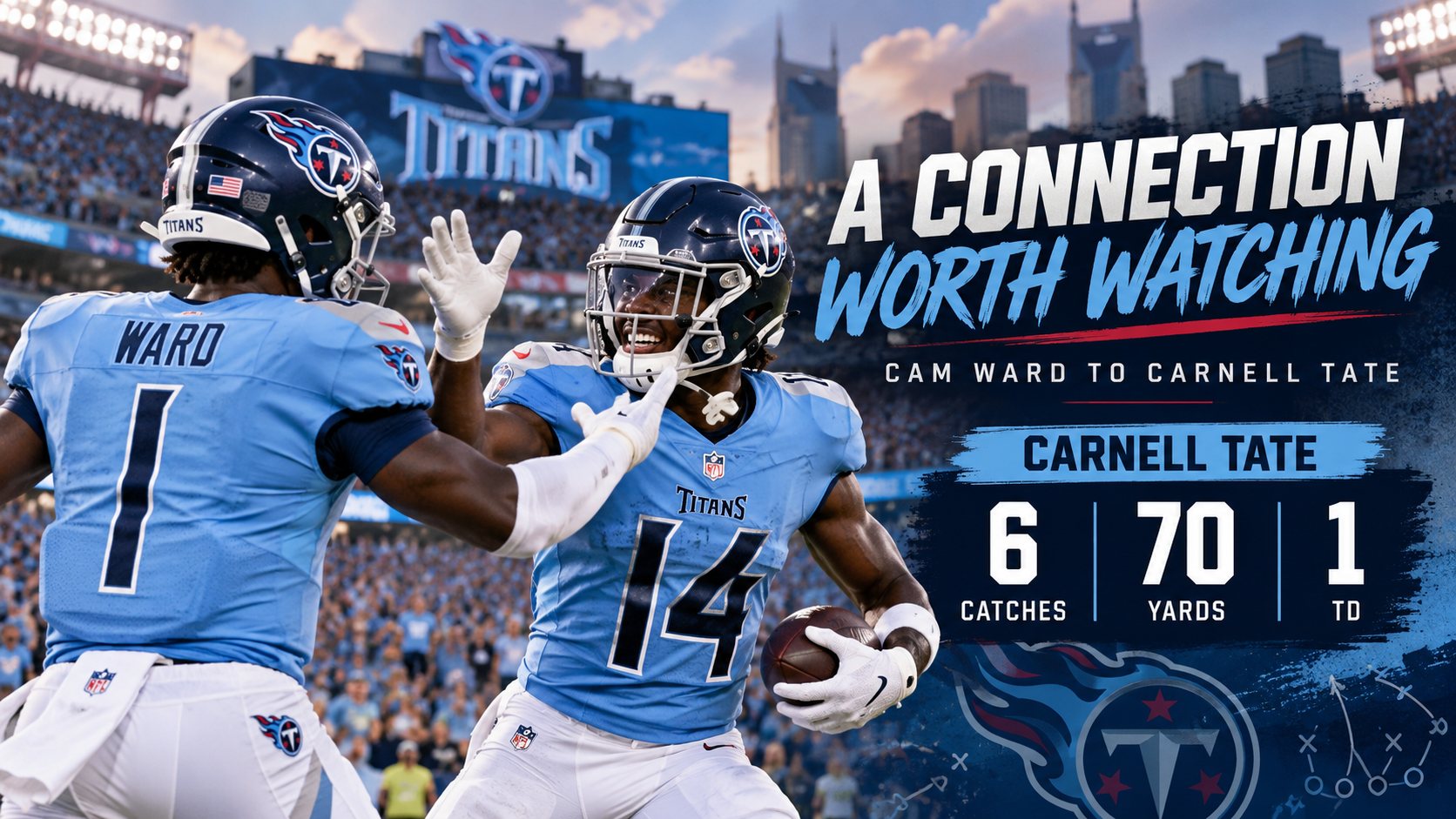
The individual lines were just as thin. Cam Ward completed 11 of 22 passes for 102 yards, one touchdown and one interception. Tony Pollard carried 19 times for 76 yards. Carnell Tate caught six passes for 70 yards and Tennessee’s only offensive touchdown — the first touchdown catch of his career.
That is not an offensive breakout. Hell, Tennessee gained one fewer total yard Sunday than it did in the 26-3 loss to Houston the week before.
That is the part worth remembering. The Titans did not suddenly figure out offense. They figured out how to win one ugly football game.
There is a difference.
The Game Changed Because Tennessee Finally Made the Big Plays
For most of the first half, Tennessee looked exactly like the team we have been watching all season. Ward threw only seven passes before halftime, completing four for 37 yards. The run game had 27 yards. Tennessee punted on every first-half possession except the last one, which ended with Ward throwing an interception under pressure. Indianapolis turned that into a 47-yard field goal and a 13-0 lead at the break.
Then the Titans started making the kinds of plays bad teams usually fail to make — and almost every one handed a struggling offense a short field or took the offense out of it entirely.
Early in the third quarter, Jeffery Simmons forced and recovered a Jonathan Taylor fumble at the Indianapolis 33, and the offense turned it into a 29-yard Joey Slye field goal. Later in the quarter came Tennessee’s best drive of the day — nine plays, 51 yards — and a 56-yard Slye field goal to make it 13-6.
Early in the fourth quarter, Chimere Dike returned a punt 58 yards to the Colts’ 23. On second down, Ward found Tate for an eight-yard touchdown to tie the game. Less than three minutes later, James Williams blocked an Indianapolis punt and Femi Oladejo returned it 14 yards for a touchdown and a 20-13 lead.
Indianapolis answered with a long drive and a four-yard Taylor touchdown run to tie it at 20 with 5:32 left. Slye closed it: a 49-yarder with 2:03 left and a 44-yarder with 43 seconds left.
Add it up. Of Tennessee’s 26 points, 17 came directly off a takeaway, a long punt return or a blocked punt. The offense’s own drives mattered, especially late, but the game swung on plays the offense did not have to create. Meanwhile, the defense sacked Daniel Jones six times and finished plus-two in turnovers.
After scoring six points in the third quarter, Tennessee erupted for 20 in the fourth — as many as it had scored in any full game all season.
That is the story of the win. Not dominance. Not offensive efficiency. High-leverage plays.
The Titans spent most of the afternoon losing the normal football game — yards, snaps, possession, sustained offense — and then won the parts that swung the scoreboard: turnovers, special teams, sacks, field position and late-game execution.
For one Sunday, that was enough.
Why Is This Offense Still So Bad?
This is the question that matters most, and it does not have a one-word answer. “Cam Ward” is too simple. So is “the offensive line.” So is “Brian Daboll.” Tennessee has problems at almost every layer of the offense — quarterback accuracy, protection, a run game that doesn’t scare anybody, too many dropped balls and a design that has produced very few explosive plays — and those problems feed each other. Here is what the numbers say about each one.
Cam Ward: What’s on Him and What Isn’t
Start with the quarterback, because everything in a rebuild eventually does. Through five games, Ward completed 63.2% of his passes for 896 yards, three touchdowns and three interceptions. That is 5.8 yards per attempt, and 5.0 net yards per attempt once sacks are counted. Sunday was worse on a per-throw basis: 11 of 22, 102 yards, one touchdown, one interception, 4.6 yards per attempt.
Those numbers are not good enough. The useful question is which parts belong to Ward.
What is on him: Pro Football Reference charted 23 of Ward’s throws through Week 5 as bad throws, a 16.2% rate — roughly one of every six passes. That isn’t drops, protection or play design. That is accuracy and decision-making, and it is the biggest thing he has to fix. His pocket management has also been a recurring theme in film breakdowns, going back to a rookie year in which he took 55 sacks, and Sunday’s interception came under pressure on the last offensive play before halftime.
What is not on him: Tennessee was charged with 13 dropped passes on Ward’s throws through five games, a 9.2% drop rate. Had every one been caught, he would be completing 71.6% instead of 63.2%. That overstates it — not every drop is an easy catch — but it shows how much of his stat line is being created by the people he’s throwing to.
The protection numbers are more mixed than the narrative. Pro Football Reference had Ward pressured on 24.0% of his dropbacks through Week 5, with an average pocket time of 2.3 seconds. That is not a quarterback running for his life on every snap, and it is fair to expect more from him when the pocket holds. But 2.3 seconds is not much time to let anything develop downfield, and a season average hides the bad weeks. Houston was a disaster.
So is Ward the problem? He is a problem. The bad-throw rate is his. But he is also working behind an uneven line, throwing to receivers who have dropped 13 balls and playing next to a run game that doesn’t force defenses to change anything. Sunday was only his fourth win as an NFL starter; he was 3-19 before it. That says plenty about the situations he has been put in — and it also says we still don’t know whether he can lift a bad situation on his own.
Sunday did not answer that question. But his touchdown to Tate, a throw that mattered in a fourth quarter where Tennessee was still alive, is exactly the kind of moment a developing quarterback needs. It did not erase the problems. It gave Tennessee something to build on.
The Offensive Line: Uneven, Not Hopeless
PFF ranked Tennessee’s offensive line 23rd heading into Week 6. That is below average, not bottom of the league, and it matches what we have seen: a group that holds up for stretches and then falls apart. The starting five was Dan Moore Jr., Peter Skoronski, Austin Schlottmann, Atonio Mafi (in for Fernando Carmona Jr.) and JC Latham, left to right. Latham has been the bright spot, with four straight games above a 65.0 PFF pass-blocking grade.
Through four weeks, the line actually carried one of the better pass-blocking grades in the league. Then Houston happened. The Texans pressured Ward on 19 of his 41 dropbacks, sacked him four times — three by Will Anderson Jr. — and hit him seven times. PFF credited Moore with a team-high seven pressures allowed and one sack. Mafi’s pass-blocking grade in true pass sets was 28.2. The line’s PFF pass-blocking grade for the game fell to 53.5, its worst of the season.
The penalties were just as damaging. After a clean first half, Tennessee was flagged seven times for 83 yards in the second half. Moore was called for three penalties himself, including a hold that wiped out a 32-yard completion to Tate. A hold on Schlottmann erased a 35-yard completion to Tyjae Spears. For an offense that struggles to create explosive plays in the first place, losing two of them to flags in one afternoon is brutal.
For Ward, that means the fair standard is not “great every week.” When the line gives him a normal week — roughly one pressure in four dropbacks — he has to be more accurate than he has been. When it gives him a Houston, almost any quarterback looks bad. Evaluating him honestly means separating those two kinds of games, and this line has produced both.
The Run Game: Real Yards, No Fear
The Tennessee run game is not literally doing nothing. Through five games, Pollard had 273 yards on 68 carries, a respectable 4.0 per carry. As a team, Tennessee had 413 yards on 108 carries — 3.8 per carry — and averaged 82.6 rushing yards per game, 27th in the league. The Titans cleared 100 rushing yards once, with 122 against Philadelphia in Week 2.
The problem is what’s missing. Pollard’s longest run through five games was 18 yards. Only 93 of his 273 yards came before contact, which means he has been creating most of his production after a defender has already reached him. That is a credit to Pollard and a knock on the blocking in front of him.
A run game like that keeps the offense on schedule some of the time. It doesn’t produce the 25-yard run that flips field position or force a defense to change how it plays, and when Tennessee falls behind, it disappears. Against Houston, the Titans ran it 18 times for 57 yards; Daboll said afterward that once it became a three-possession game in the fourth quarter, they were forced to throw against a tough front.
Sunday followed the same pattern. Pollard’s 19 carries for 76 yards were useful, workmanlike, 4.0 per carry. But Tennessee had 27 rushing yards at halftime and did not score on the ground. The run game helped the Titans survive. It did not make Ward’s job meaningfully easier.
Brian Daboll’s Share of It
Robert Saleh is the head coach, but the offense belongs to Brian Daboll. He is the offensive coordinator and the play-caller, which means the design, the early-down approach, the protection answers, the run-pass balance and the plan for developing Ward all run through him.
Some of the evidence is unflattering. Through two weeks, only Atlanta’s Cooper Rush had a lower average target depth than Ward, and Tate had not been targeted on a single pass 20 or more yards downfield. Through five weeks, Ward’s intended air yards per attempt sat at 6.8, with 4.8 yards after the catch per completion. That is an offense that throws short and doesn’t gain much after the catch — a hard way to live for a team that also can’t run for explosives.
To be fair to Daboll, short throws are a defensible way to protect a young quarterback, and at least one film breakdown credited his early quick-game sequencing with giving Ward easy completions. But a quick game only works if it creates yards after the catch or sets up shots downfield. Through five weeks, it hadn’t done enough of either.
His high-leverage calls have also drawn fire. In Week 4 at Baltimore, trailing 14-7 and facing fourth-and-goal from the 2, Daboll put Pollard in a Wildcat look — taking Ward out of the play as a passing threat — and the Ravens stuffed it. In Week 2 against Philadelphia, a late red-zone sequence inside the 10 fell apart. And Sunday, Ward threw just seven passes in the first half. Whether that was the game plan, the game script or a lack of trust in the quarterback, it is a pattern worth watching.
Daboll’s public message has centered on early downs — “early down production is important,” he said before the Colts game — and, asked about Moore’s protection on a widely shared blitz play from the Houston game, “we need to do a better job all the way around.” Both are true, and both are his job to fix.
The fair verdict: Daboll is not the reason Ward misses one of every six throws. But he owns an offense that has been too short, too slow to create explosives and, in a couple of big spots, overthought.
Carnell Tate Might Be One of the Pieces That Actually Matters
If there was one offensive development Sunday that should make Titans fans feel genuinely good, it was Carnell Tate.
Six catches. 70 yards. The first touchdown catch of his career.
The context makes it stronger. Ward threw for 102 yards Sunday, and Tate accounted for 70 of them — 69% of Tennessee’s passing yardage, on six of Ward’s 11 completions. On a day when almost nothing else worked through the air, Tate was the passing game.
That wasn’t a one-week thing. Through five games, the rookie — Tennessee took him fourth overall — had 23 catches on 37 targets for 274 yards, about 31% of Ward’s passing yards. He had already put together a nine-catch, 145-yard day against Baltimore, the first 100-yard game by a Titans receiver since Calvin Ridley had 131 against Arizona last season. After Sunday, he is at 29 catches for 344 yards through six games.
He has not been perfect. He fumbled after a catch in that Baltimore game, and through the first two weeks he had not been targeted on a single pass 20 or more yards downfield. Six games is not enough to call anybody a star, and he isn’t one yet.
But the question is worth asking: Is Tennessee discovering a legitimate building block?
Rebuilding teams need more than a quarterback. They need players who can grow with him. A real Ward-to-Tate connection — the receiver Ward trusts on third down, the one a defense has to account for — is how a young offense starts to get an identity. It would also make Ward easier to evaluate: give him one dependable target, and whether the production climbs tells you something either way.
We are nowhere near ready to declare that finished. But right now, Ward-to-Tate is the closest thing Tennessee’s offense has to a foundation.
The Defense Deserves More Credit Than the Final Score Gives It
Giving up 399 yards over 78 plays and more than 38 minutes is not normally something to celebrate.
But the defense changed the game when it had opportunities. Six sacks of Daniel Jones — the Titans’ defense had 10 in its first five games combined. Three takeaways. Amani Hooker flying around for a career-high 13 tackles and an interception. Simmons forcing and recovering the fumble that produced the first points of the second half.
More importantly, the defense kept Tennessee close enough for the weird stuff to matter. Hooker’s interception ended a Colts drive at the Tennessee 6, and Cor’Dale Flott’s interception at the 11 killed another scoring threat. That is as many as 14 points that never went on the board. If the Colts turn those yards and that possession advantage into touchdowns instead of mistakes, this game is over before the fourth quarter.
Instead, Tennessee hung around. That gave the blocked punt, the Ward-to-Tate touchdown and Slye’s kicks a chance to mean something.
That is not a formula you want to rely on every week. But it is how struggling teams sometimes have to win before they become good enough to win normally.
Special Teams Flat-Out Stole Points
The blocked punt touchdown was the single biggest play of the afternoon. When an offense is struggling to drive the football, there may be nothing more valuable than scoring without asking that offense to move 70 or 80 yards. Williams got a hand on the punt, Oladejo carried it 14 yards into the end zone, and Tennessee led 20-13.
It wasn’t the only special-teams swing. Dike’s 58-yard punt return set up the Tate touchdown at the Colts’ 23, which meant the offense needed only two plays to score its only touchdown. Then Slye made four field goals, including the 56-yarder and the two fourth-quarter kicks that won it.
That matters because Tennessee had not shown many different ways to win through five weeks. Sunday, it found one.
It was ugly as hell. But it counted.
They Also Finally Beat Indianapolis Again
There is some real fan-level satisfaction buried in this one too.
Indianapolis had won six straight meetings against Tennessee coming into Sunday. Before that Colts streak, the Titans had won five straight in the series from 2020 through 2022. Tennessee’s last win over Indianapolis came back on Oct. 23, 2022, a 19-10 win in Nashville. Its last win at Lucas Oil Stadium came three weeks earlier, on Oct. 2, 2022.
So yes, it had been a while.
This team has not had much to celebrate lately. Ending a six-game losing streak to a division rival on the road is at least something. It is also Robert Saleh’s first win as Tennessee’s head coach.
Nobody is hanging a banner for that. But when you start 0-5, you take the first win wherever you can get it.
This Is Why One Win Should Not Blow Up Your Power Rating
This is also where the betting side of football matters.
A casual bettor sees Titans 26, Colts 20, and starts thinking: Maybe Tennessee is turning it around. Maybe it is time to start buying them next week.
Slow down.
The predictive information still says plenty went wrong. Tennessee was outgained by 213 yards. It ran 33 fewer plays and picked up 13 fewer first downs. It lost the possession battle by more than 17 minutes. Its quarterback threw for 102 yards. And the Titans needed a plus-two turnover margin, six sacks, a 58-yard punt return and a blocked-punt touchdown to win by six.
Turnovers and special-teams touchdowns are enormous when they happen, but you should not project them to repeat every Sunday. Take away the blocked punt, and Tennessee scored 19 points — in line with this offense’s best days, not above them.
That does not make Tennessee’s win fake. It makes the distinction between result and process important.
A team can play well and lose. A team can play badly and win. Sunday, Tennessee did enough of the high-value stuff to win a game while still showing many of the same underlying problems that made it 0-5.
That is exactly why power ratings should move because the information changed — not because the standings finally put a 1 in the win column.
So What Actually Improved?
This is where the win does matter, as long as you are honest about which parts can travel.
The first thing is the response. Down 13-0 at halftime after five straight scoreless quarters, Tennessee outscored Indianapolis 26-7 the rest of the way. For a team that had spent five weeks looking dead whenever a game went sideways, not folding has value. It is hard to measure and may not repeat, but it is the first time this season the Titans have survived a bad start.
The 20 fourth-quarter points are the most visible improvement, with a footnote: seven came on the blocked punt and seven more on a drive that started at the Colts’ 23. The finishing was real. The offense that finished was mostly handed the ball close.
The pass rush is the improvement most likely to carry over, because pressure comes from personnel and scheme. But six sacks in one game, against 10 in the previous five combined, is a spike, not a new baseline. Three or four a game, consistently, would be real.
The takeaways, the blocked-punt touchdown and the 58-yard punt return are the least repeatable parts. They were big, legitimate plays, and they won this game. They are also the kind of thing that swings back toward average, and building expectations around them is how you get burned.
The late field goals are more stable. Slye came into Sunday 5-for-6 on the season and added four more, including a 56-yarder. A kicker you trust in the final two minutes is a repeatable advantage for a team that will play a lot of close, low-scoring games.
And the Titans beat a division rival that had owned the matchup for six straight games, on the road, for their first win of the season.
It does not mean the Titans are suddenly good. It means they finally showed they can finish a football game. That is a small step, and a 1-5 team should be allowed to appreciate small steps.
What Still Looks Bad?
A lot, and it is measurable.
Through five games, Tennessee was 32nd in scoring at 11.6 points per game, 32nd in total offense at 246.4 yards per game and 32nd in time of possession at 24:31. By drive, it was even starker: the Titans scored on just 23.4% of their possessions and averaged 1.21 points per drive, both last in the league. They averaged 5.0 net yards per pass attempt, 31st, and 3.8 yards per rush.
The interesting part is what isn’t driving it. Tennessee ranked 13th in turnover rate per drive, so this is not simply an offense giving the ball away. The problem is simpler and worse: when the Titans don’t turn it over, they still don’t score. They averaged just 26.3 yards per drive, 27th in the league, and started their drives on average at their own 26.8, the worst starting field position in the NFL.
Now look at Sunday. 186 total yards. 11 first downs. 4.1 yards per play. 102 passing yards. Every one of those numbers is in line with — or worse than — what made Tennessee 0-5.
So how does a team win while the underlying problem stays put? Exactly the way Tennessee did. It flipped the thing that had worked against it all season — field position — through takeaways and special teams. The 14 points from the Tate touchdown and the blocked punt didn’t require the offense to do what it can’t: drive the ball 70 or 80 yards.
That is the real work. The Titans still need better offensive efficiency: more first downs, longer drives, more passing production and better early-down success. Most of all, they need to create points without chaos handing them the opportunity.
The Future Is Still About Cam Ward — Not a Wild-Card Chase
At 1-5, the rest of this season should not suddenly be framed as some miracle playoff push because Tennessee finally won a game.
The important question is whether this roster looks more functional in December than it does in October, and that starts with Ward cutting that one-in-six bad-throw rate and handling pressure without the sacks and forced throws. Around him: Can Tennessee protect him consistently enough to evaluate him honestly? Can Tate keep developing into a true No. 1 target? Can Saleh build a defense that creates pressure without needing turnover spikes? Can Tennessee stop playing from behind every week?
The record matters, obviously. But for a young, flawed team, development matters more than pretending one win changes the entire season.
The Next Two Weeks Are Actually Useful Tests
Tennessee comes home next Sunday to face Cleveland, which is 4-2. Then it goes to Cincinnati before the Week 9 bye.
That gives the Titans two games to show whether Indianapolis was a weird afternoon or the beginning of something slightly more repeatable. The standard should not be “win both or the season is over.” It should be improvement you can see and measure. Here is what to watch:
- 300 offensive yards. Tennessee averaged 246.4 through five games and had 186 Sunday.
- Ward above 6 yards per attempt. He was at 5.8 through five games and 4.6 Sunday. Above 6.0 means the passing game is creating something beyond the short stuff.
- Longer drives. The Titans scored on 23.4% of their drives through five games, and their only touchdown drive Sunday started at the Colts’ 23. One touchdown drive of 60-plus yards would be meaningful.
- An explosive run. Pollard’s long run through five games was 18 yards. A few 20-plus-yard runs would change how defenses play this offense.
- Clean protection. Against Houston, Ward was sacked four times and two big completions were wiped out by holds. Watch the sacks, and whether flags keep erasing the plays this offense can least afford to lose.
- Tate’s targets. Through five games he had 37 targets and about 31% of Ward’s passing yards. If he keeps commanding that share and producing on it, the connection is real.
- Scoring in the 20s without help. Tennessee has not scored 21 or more points this season without a defensive or special-teams touchdown. Doing it once would say more than Sunday did.
If those things start improving, the win in Indianapolis becomes more interesting.
If the offense goes right back to 150-200 yards and Tennessee loses, then Sunday was exactly what the box score suggested: one ugly win created by turnovers and special teams.
Enjoy the Win. Keep the Expectations Where They Belong.
The Titans finally won.
Good.
Fans should enjoy it.
Players should enjoy it.
Saleh should enjoy his first win as Tennessee’s head coach.
Ward should enjoy getting off the zero in the win column this season.
And beating Indianapolis for the first time since 2022 makes it sweeter.
But this is not the point where we pretend Tennessee has turned the corner.
The offense still produced 186 yards.
The quarterback still threw for 102.
The Titans still needed three takeaways, six sacks and a special-teams touchdown to overcome a game Indianapolis controlled for long stretches.
That is not a blueprint.
It is a survival story.
And for a 1-5 team trying to figure out which pieces belong in its future, maybe that is enough for one Sunday.
The Titans won.
They are still bad.
Both things can be true.
The next question is whether, a week from now, they can look a little less bad while doing it again.