
Is she an elite WNBA star, an overrated rebound collector, or the most misunderstood frontcourt player in basketball? The numbers make both extreme answers uncomfortable.
There might not be a more polarizing player in women's basketball than Angel Reese.
One corner of the internet watches her collect rebounds, guard multiple positions and pile up double-doubles and sees an elite star. Another corner watches her miss a short shot, collect the ball, miss again and declares her the most overrated player in the league. Then come the memes, the replies and a word that seems impossible to escape: “mebounds.”
A good nickname can make a highlight go viral. It cannot, by itself, explain basketball value.
The real question is more interesting. Reese was traded from Chicago to Atlanta in April. In her first Dream season, she averaged 16.4 points, 12.1 rebounds and 1.8 steals, won the WNBA's Defensive Player of the Year, and helped Atlanta reach the Finals. Chicago, meanwhile, went from 10 wins to 16 after her departure. In Game 2 of the Finals, Reese answered criticism from Game 1 with 30 points and 16 rebounds.
That's enough ammunition for every argument—and enough context to suggest the obvious takes aren't very good.
Let's break down the rebounds, the shooting, the defensive value, the trade and what all of this means if you look at basketball through the lens of probability instead of loyalty.
Are “mebounds” real? Yes. Do they explain her rebounding? No.
A mebound is a rebound collected by the player who missed the immediately preceding shot. The term started as a dig at Reese because clips of her recovering her own missed layups attract attention.
There is an actual study of this. The Mebound, an independent play-by-play analysis corrected on October 19, examined the 2024–2026 WNBA regular-season sample through July 25, 2026. It counted 132 rebounds off Reese's own misses among 1,111 total rebounds, or 11.9%. The study's league comparison was 5.8% of rebounds being own-miss recoveries. These figures are from the study's historical cutoff, not her final 2026 season total.
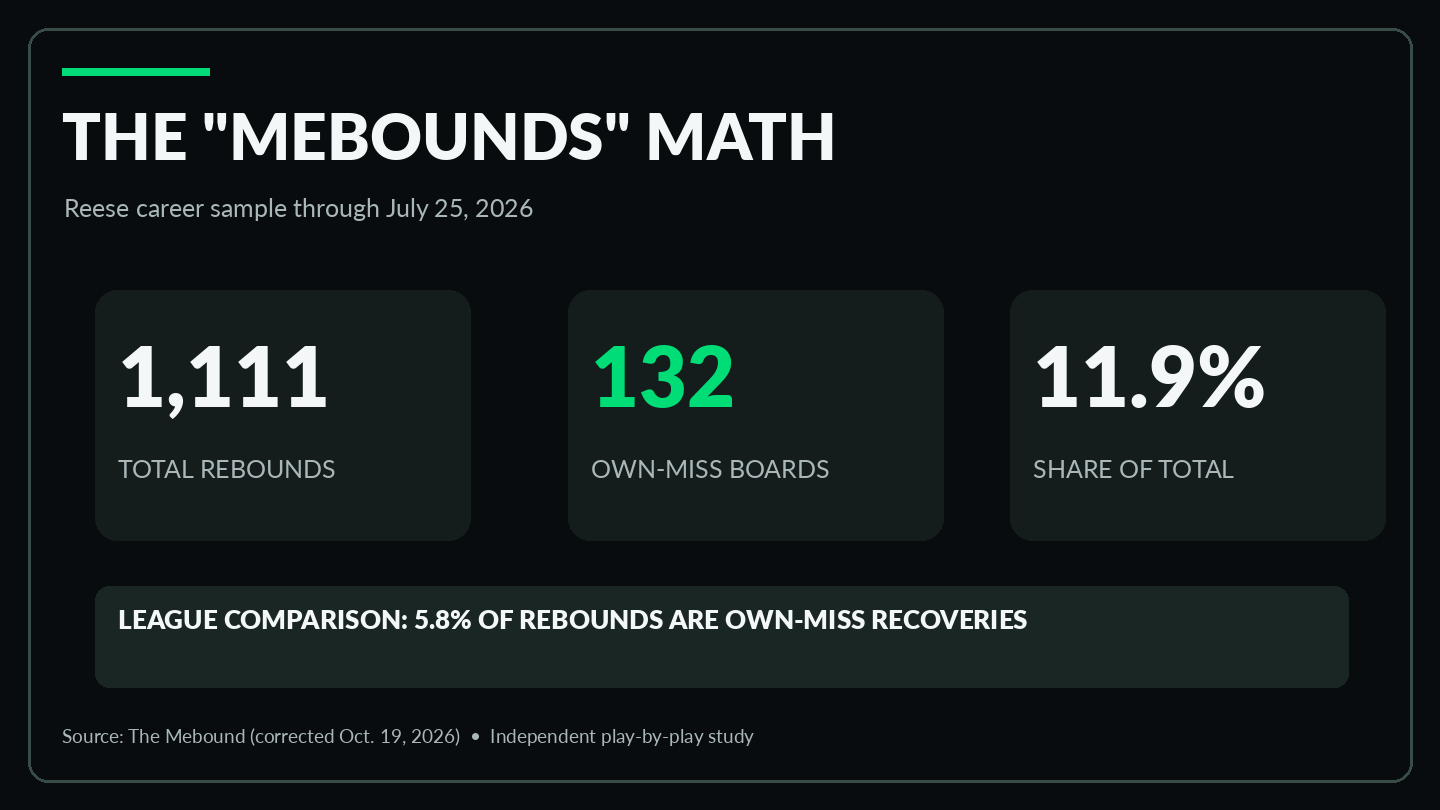
Read those numbers carefully. Reese gets her own misses back unusually often. Pretending otherwise is just as selective as the people mocking her. Her 11.9% share is roughly double that 5.8% comparison on the same share of total rebounds definition. The study also reports that she recovered about 18–23% of her own missed field-goal attempts, depending on season; that is a different denominator and should not be confused with the 11.9% figure.
Now flip the argument over. If 11.9% were mebounds in this sample, roughly 88.1% were not. Removing her own-miss recoveries still leaves 979 other rebounds in the sample—defensive rebounds and offensive rebounds off teammates' misses. That's not a fake rebounding resume.
A missed layup hurts scoring efficiency. An offensive rebound saves or extends the possession. Both facts count. It's better to score on the first try, obviously. It is also better to recover your miss than surrender the ball. The rebound cannot magically make the initial shot efficient, and the initial miss doesn't make the rebound worthless.
Our verdict on the nickname: funny, statistically grounded in one narrow sense, and wildly incomplete as an evaluation of her game.
Research note: This is an independent study using play-by-play classification, not a league-issued official “mebounds” statistic. The authors issued an explicit correction on October 19; we use the corrected 132/1,111 figures.
Three seasons of production—and a very real offensive weakness
Put the jokes away and look at the actual regular-season numbers:
| Reese per game | 2024 Chicago | 2025 Chicago | 2026 Atlanta |
|---|---|---|---|
| Points | 13.6 | 14.7 | 16.4 |
| Rebounds | 13.1 | 12.6 | 12.1 |
| Assists | 1.9 | 3.7 | 2.8 |
| FG% | 39.1% | 45.8% | 45.1% |
| Steals | 1.3 | 1.5 | 1.8 |
| Blocks | 0.5 | 0.7 | 0.7 |
The rebound production has not vanished after the move. Twelve boards a night in a league full of elite athletes is legitimate. Her scoring volume has increased, too.
But volume is not the same as efficiency. In 2026 she shot 45.1% from the field and 19.3% from three, on approximately 1.3 three-point attempts per game. Her 52.4% true shooting is better than her rookie mark but not evidence of an elite scoring efficiency profile. Her shooting is still a substantial area for development.
That matters because defenses notice. If you do not force a defender to respect your jumper, that defender has more freedom to help at the rim, clog driving lanes and crowd teammates. A player can gain possessions through offensive rebounding while costing a little spacing on the original possession. The right evaluation captures both effects.
She's not a finished, polished three-level scorer. Nobody looking honestly at the shot profile should say that.
And she's not just an empty-stat rebound collector. Nobody looking honestly at the possession data should say that either.
Chicago traded her. Who actually won?
On April 6, 2026, Chicago sent Reese to Atlanta. Chicago received Atlanta's 2027 and 2028 first-round picks. Atlanta received 2028 second-round pick-swap rights as part of the deal.
That is a meaningful price for a player whose value divides opinion. Chicago chose future assets and roster flexibility. Atlanta chose an established rebounder and defender entering her third WNBA season.
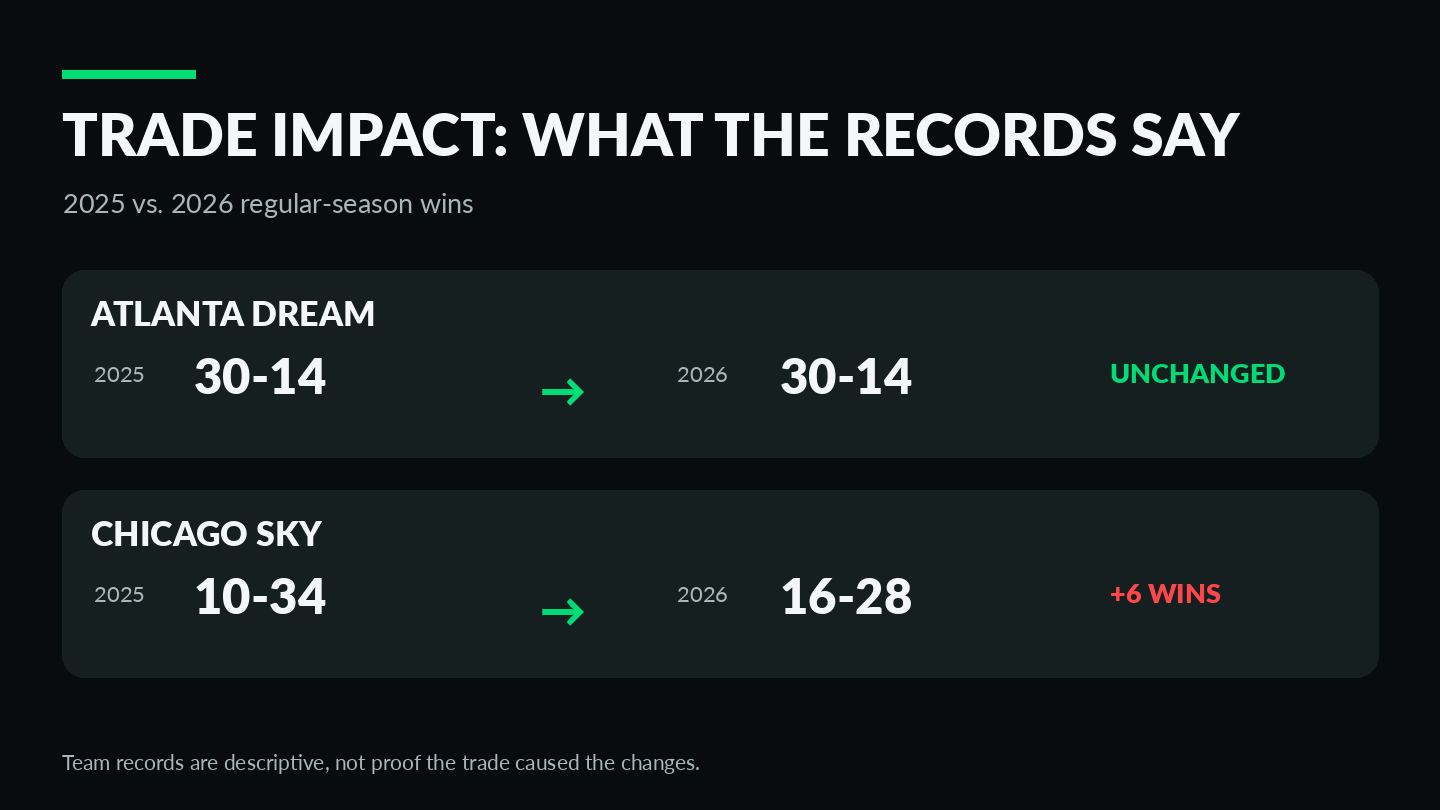
The before-and-after records make for an irresistible headline:
| Team | 2025 record | 2026 record |
|---|---|---|
| Atlanta Dream | 30–14 | 30–14 |
| Chicago Sky | 10–34 | 16–28 |
Chicago improved by six wins without Reese. Atlanta won the same number of regular-season games as before she joined. That's the complete, not-so-convenient version of the scoreboard argument.
Did Chicago get better because Reese left? The record alone cannot tell us. Rotations, rookies, coaching decisions, health, team chemistry and the rest of the roster changed. And 16–28 is improvement, not a victory parade.
Did Reese single-handedly make Atlanta a contender? No. Atlanta was already a 30-win team in 2025. It had Allisha Gray, Rhyne Howard, Jordin Canada, Naz Hillmon and a strong system under Karl Smesko. Giving one player all the credit ignores the foundation she joined.
What Atlanta did gain was a particular kind of player: somebody who can turn a missed shot into another chance and turn a defensive stop into an actual end of possession. That can be extremely useful beside perimeter scorers.
The trade's eventual winner cannot be known fully until those draft assets become actual players and the seasons afterward unfold. Fans want an instant scoreboard; the real evaluation takes longer.
Atlanta's offense changed—but not in the way a highlight reel suggests
Atlanta scored 91.3 points per game in 2026, up from 84.4 in 2025. That's a headline-sized improvement. But context matters.
The Dream also played faster: its pace increased from roughly 76.2 to 80.7 possessions per 40 minutes. More possessions usually mean more points even when efficiency barely changes. Atlanta's offensive rating moved from about 110.5 to 112.9, an improvement, while its net rating actually declined from +10.0 to +8.4.
So Reese didn't walk into Atlanta and make every component of the team better. That's not what the numbers say.
Her fit is still easy to understand. Smesko's perimeter-oriented offense creates misses from distance. An aggressive offensive rebounder makes those misses less final. Kick-out rebounds can produce second attempts or force a scrambled defense to react again. Defensive boards can get the ball moving quickly in the other direction.
That is real team value, but it comes from the entire five-player unit. We would need lineup-level, possession-level modeling—not raw points per game—to separate Reese's share of the change from the rest of Atlanta's decisions.
Think of it like this: a rebounder isn't necessarily the engine of an offense. Sometimes she's the extra fuel that keeps the engine running after a possession should have ended.
Defense is the strongest part of her case
On October 1, the WNBA named Reese its 2026 Kia Defensive Player of the Year. She was also a member of the league's All-Defensive First Team. That's a genuine achievement, not a fan poll.
Reese finished with 3.39 defensive win shares, 7.3 defensive rebounds per game, and Atlanta allowed about 7.9 fewer points per 100 possessions while she was on court than while she sat, according to the Dream's official award announcement. She also averaged 1.8 steals and 0.7 blocks.
On/off data needs a warning label: it reflects who else played with and against her, not just her isolated skill. It's not proof that one defender personally prevented every point in the differential.
But the total picture matters. Defensive activity, rebounding volume, the ability to complete stops, and formal league recognition all support the same conclusion: her defensive contribution is a major strength.
Defense is more than blocked shots. It includes rotating early, holding position, contesting without fouling, disrupting actions and securing the miss. A team doesn't actually get the ball back just because an opponent's shot misses the rim. Somebody has to finish the possession.
It's reasonable to question her shot selection or offensive spacing. Ignoring her defense because a missed layup went viral is much harder to justify.
Game 2 of the Finals gave both camps something to think about
The 2026 Finals opened with Atlanta losing 68–64 to Golden State. Reese had 14 points and 12 rebounds in Game 1, but the Dream struggled late.
Then, on October 19, came Game 2. Reese scored 30 points on 10-of-16 shooting, grabbed 16 rebounds, and helped Atlanta win 79–65, tying the series 1–1 as of this article's October 20 publication date.
That's a legitimate big-game performance. It doesn't require a clever nickname or an invented advanced metric to matter. She scored efficiently that night, controlled the glass and helped her team win a Finals game.
Does a single outstanding night prove she's now a top-tier scorer every night? Of course not. Does the bad finishing from another game prove she can never score efficiently? Also no.
The honest approach is to update your assessment when new information arrives while remembering how much weight one game should carry. That's true in basketball and it's true in sports betting.
Celebrity, reputation and basketball ability aren't interchangeable
Reese attracts attention. Fans argue about her, sponsors recognize her, and almost every appearance becomes content. That is a form of commercial value, but it is not itself proof of on-court efficiency.
The opposite mistake is just as common: assuming a player can't be genuinely valuable because the media attention feels excessive.
Good basketball analysis should survive without liking or disliking the personality involved. We shouldn't award free points for fame or subtract rebounds because the comments section doesn't approve of someone's attitude.
So strip it down. What repeatable skills does she bring? What possessions does she extend? Which types of shots is she good at creating and converting? Can opponents target her limitations? What lineup makes her strengths valuable while minimizing her weaknesses?
Those questions are harder than mocking a clip. That's precisely why they're worth asking.
How would we evaluate her from a betting perspective?
Outprice The Book studies price versus probability. Reese is a useful example of how a narrative can be right in one respect and misleading in another.
If the market offers a rebound prop, it isn't enough to know she is an elite rebounder. You need a forward-looking estimate of minutes, available missed shots, offensive and defensive rebound chances, opponent shot profile, teammate competition and the actual line and odds. If a sportsbook has already priced every one of those factors, there may be no value whatsoever.
If the market offers a points prop, the analysis changes. We care about projected shot volume, touches, minutes, matchup, free throws and a reasonable distribution of finishing outcomes—not the memory of a 30-point Finals game alone.
In both cases, price matters. A good player can be a bad bet at the wrong number. A weak game can still occur after a properly priced bet. No nickname, award or rivalry changes that arithmetic.
We're not issuing a Reese player-prop recommendation here. The lesson is about method: separate underlying skill from reputation, and separate skill from the sportsbook's asking price.
Our basketball evaluation
This is editorial judgment, not an official league rating or numerical player ranking.
| Skill | Current assessment |
|---|---|
| Rebounding and second-chance creation | Elite strength |
| Defensive rebounding and versatility | Strong; supported by 2026 award and metrics |
| Interior physicality and effort | Major strength |
| Scoring volume | Improved in Atlanta |
| Shot efficiency and perimeter spacing | Real limitation |
| Passing and offensive decision-making | Capable, still inconsistent |
| Overall role | High-impact frontcourt contributor with room to improve |
She's not A'ja Wilson as an all-around scoring package. She's a different type of valuable player. That's okay. Basketball isn't a contest to see who can fit everybody into one superstar template.
Atlanta chose to build around the things she does well, and the Finals run shows she can be part of a contender. Chicago chose to collect future assets; whether that was correct is still an open question.
So how good is Angel Reese, really?
Here's where we land: Angel Reese is an elite rebounder, an accomplished defender and a high-impact WNBA frontcourt player with significant offensive limitations.
The “mebounds” statistic is real. It accounts for a minority of her rebounds. It is not proof her other rebounds don't count, and it doesn't excuse inefficient misses.
The Chicago-to-Atlanta trade is real. Chicago improved its record and Atlanta matched its prior regular-season win total. Neither fact isolates Reese's individual effect.
Her Defensive Player of the Year award is real. So are the shooting percentages. So is that 30-point, 16-rebound Finals performance.
Fans are free to debate how much those things are worth. That's the fun part. But they don't get to throw out the evidence that doesn't fit their side.
The funniest thing about the Angel Reese debate is that both sides have a point. Neither side wants to admit it.
And that is exactly why the story is more interesting than another compilation of missed layups.
Outprice The Book — Find the Edge. Beat the Price.
Independent sports commentary and statistical analysis. Not a betting recommendation. All Finals facts are current through October 20, 2026; the series was 1–1 as of publication. Cover/social art is AI-generated editorial illustration, not a photograph of an actual game.
Sources and methodology
- The Mebound — original independent play-by-play study, corrected October 19 — 132/1,111 and league comparison; historical cutoff July 25, 2026.
- WNBA official — 2026 Defensive Player of the Year — award and defensive accomplishments.
- Atlanta Dream — April 6 trade announcement — exact trade consideration.
- Basketball-Reference — Angel Reese regular-season statistics — 2024–2026 averages and shooting.
- 2026 Atlanta Dream team statistics and 2025 league standings — team records and scoring context.
- 2026 Chicago Sky team statistics — post-trade record.
- WNBA official — 2026 Finals Game 2 recap — series situation, box score, Reese's performance.
- Atlanta Dream — Defensive Player of the Year announcement — team-quoted defensive on/off and win shares.
- Atlanta Dream — 2026 WNBA All-Defensive Team honors (October 15, 2026) — Reese named to the 2026 All-Defensive First Team.
- WNBA official — 2026 Finals Game 1 recap — Game 1 result (68–64) and Reese's 14 points and 12 rebounds.
- 2025 Atlanta Dream team statistics — 2025 regular-season scoring, pace and ratings.
Editorial policy: Source figures reflect their stated date and definition. The mebound study is independent, not an official WNBA statistic. Team record changes do not establish a causal effect of a trade. On/off differentials are descriptive, not an isolated player-impact estimate.